
The Pattern That Refuses to Die
If you're an Indian cricket fan, the trauma is deeply ingrained in your DNA. You see a tall, lean fast bowler with the ball in his left hand, marking his run-up on the morning of a crucial ICC knockout game, and your stomach immediately drops. You know exactly what is coming. You've seen this movie before, and it always ends with the Indian top order in tatters within the first six overs.
For a country that produces the most technically gifted right-handed batters in the history of the sport, the inability to play left-arm fast bowling remains one of the most baffling anomalies in modern cricket. The names change, Amir, Boult, Starc, Afridi, Topley, Jansen, but the result is almost always the same: edges to the keeper, stumps shattered, pads trapped in front of the wicket.
It's not a coincidence. It's not a run of bad luck. And it certainly isn't a lack of talent. It is a fundamental, decade-long technical vulnerability that the most expensive and resourceful cricket board in the world has failed to solve. Let's break down the actual geometry of this left-arm menace and understand why the best batters in the world suddenly look like amateurs.
The Geometry of Destruction
To understand why this happens, you need to understand the basic geometry of the cricket pitch. When a left-arm fast bowler bowls over the wicket to a right-handed batter (which India's top order almost exclusively consists of), the ball is naturally angling across the batter, moving away from the body toward the slip cordon.
The batter has to play at it. Because of the bowler's release point, the trajectory makes it look like the ball is targeting the off-stump. If the batter shoulders arms (leaves the ball), they risk the ball crashing into the stumps. This natural angle alone is tricky to negotiate, but it's not the real killer. The killer is the late inswing.
Bowlers like Boult and Afridi use that natural, wide angle to set a psychological and physical trap. The batter prepares for the ball to hold its line and go across him. He plants his front foot accordingly, committing his body weight forward and across. But at the very last fraction of a second, the ball swings back violently in the air toward the batter's toes.
By the time the batter's brain processes this sudden change in trajectory, his front foot is already planted in the wrong position. The bat comes down crooked, desperately trying to compensate for the movement. The result? The ball crashes into the pads (LBW) or finds the tiny gap between the bat and pad, shattering the stumps.
The Ghost of Mohammad Amir (2017 Champions Trophy Final)
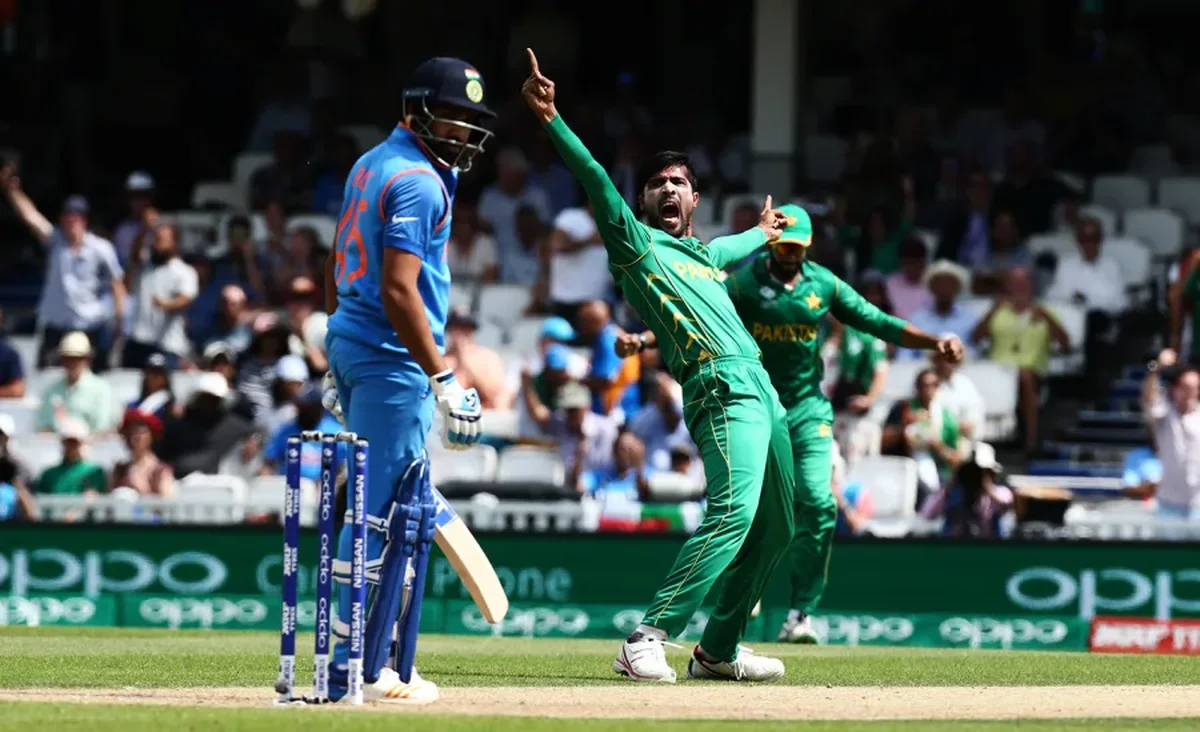
The modern origins of this nightmare trace back to The Oval in London, June 18, 2017. The Champions Trophy Final between India and Pakistan.
India was chasing 339, a steep but manageable total for a batting lineup featuring Rohit Sharma, Shikhar Dhawan, and Virat Kohli. Mohammad Amir took the new ball. He bowled three deliveries to Rohit Sharma, angling them across. On the third ball, Rohit planted his foot, expecting the angle. Instead, Amir pitched it up and swung it back in violently. Plumb LBW. Out for 0.
Two overs later, he set up Virat Kohli with the exact same tactic. He dropped Virat at slip on a ball angling across, only to get him out the very next delivery with a ball that seamed back slightly. The Indian top order was destroyed in a matter of minutes. The psychological scar left by that opening spell has never truly healed.
Trent Boult: The Smiling Assassin (2019 World Cup)
Fast forward two years to the 2019 World Cup Semi-Final in Manchester. The opponent changed, but the weapon was exactly the same.
Trent Boult and Matt Henry (a right-armer exploiting the left-arm pressure) decimated India. Boult’s ability to swing the ball back into the right-handers under heavy, overcast skies made him unplayable. He trapped Virat Kohli LBW with a textbook incoming delivery. The ball pitched on middle, swung late, and trapped Kohli squarely in front of the stumps. The Indian top order was reduced to 5/3, and the World Cup dream ended there.
Mitchell Starc and the 2015 Heartbreak

The curse extends back to the 2015 World Cup Semi-Final in Sydney. Chasing a massive 328 against Australia, the Indian top order had to negotiate Mitchell Starc at the absolute peak of his powers.
Starc used his left-arm angle from over the wicket to constantly pull the Indian batters wide. While he didn't take all the top-order wickets himself, his opening spell created such immense pressure that the Indian batters eventually cracked. Starc's sheer pace and angle set the blueprint that Amir and Boult would perfectly execute in the following years.
Why Elite Batters like Rohit and Kohli Fall For It
It sounds incredibly simple on paper: just don't plant your front foot so early. Just play late. But cricket at 145 kmph doesn't happen on paper.
Rohit Sharma is naturally an elegant player who relies heavily on timing and hand-eye coordination. His front foot doesn't move massively toward the pitch of the ball. When a left-armer swings it back into his pads at high speed, his hands are often too far away from his body to bring the bat down in time. He gets caught on the crease.
Virat Kohli, on the other hand, has a completely different issue. Kohli has a strong tendency to thrust his front foot firmly forward and across the crease to cover the line of the ball. This is what makes him so dominant through the covers. However, when an Amir or Boult bowls that incoming delivery, Kohli's front pad is effectively a giant target blocking his own bat from making contact with the ball. He essentially traps himself.
The BCCI's Structural Problem
So why hasn't the BCCI, with all its billions of dollars, advanced analytics, and world-class coaching staff, solved this problem? The answer is brutally simple: You cannot practice what you do not have.
Since Zaheer Khan retired, India has not produced a world-class, menacing left-arm fast bowler who consistently plays all formats. Ashish Nehra had a brief resurgence. Khaleel Ahmed and Arshdeep Singh are currently carrying the baton, primarily in T20s. But none possess the lethal late swing of a Boult or an Amir in the longer formats.
Consequently, Rohit, Kohli, and Rahul do not face elite left-arm pace in the nets day in and day out. You can use left-arm side-arm throwdown specialists (like the famous Nuwan Seneviratne employed by India). You can program bowling machines to swing the ball back in from a left-arm angle. But you simply cannot replicate the subtle wrist position, the late dip, the release point, and the psychological terror of a Trent Boult running in with a new ball in a World Cup knockout match.
The Indian batters only face this unique, terrifying threat when it matters most on the global stage. And by the time they step onto the pitch to figure it out, they are already walking back to the pavilion.
Frequently Asked Questions
Why do Indian batters struggle so much against left-arm pace?
The natural angle created by a left-arm bowler over the wicket forces right-handed batters to play at deliveries angling across them. When the ball swings late back into the pads (inswing), it exploits the gap between bat and pad, leading to bowled and LBW dismissals.
Which left-arm bowlers have dismissed India's top order in knockouts?
Trent Boult (2019 WC Semi), Mohammad Amir (2017 CT Final), Shaheen Afridi (2021 T20 WC), and Mitchell Starc (2015 WC Semi) are the most notable examples who have wrecked India's batting lineup.
Why doesn't the BCCI just train batters against left-arm pacers?
While they use side-arm throwdown specialists and bowling machines, nothing replicates the match pressure, natural trajectory, and late swing of a world-class left-arm fast bowler. Since India lacks an elite left-arm pacer in their own ranks, the batters don't face this quality in the nets.
Who was India's last great left-arm fast bowler?
Zaheer Khan, who retired over a decade ago, remains India's greatest and most successful left-arm fast bowler, playing a crucial role in the 2011 World Cup victory.
Does Virat Kohli have a specific weakness against this bowling type?
Yes, Virat Kohli tends to plant his front foot far across his stumps early in the innings. If the ball swings late into him, his front pad obstructs his bat, making him highly susceptible to LBW decisions.
Are left-handed batters better at facing left-arm pacers?
Generally, yes. Left-handed batters have a better sightline against left-arm pace, and the angle doesn't pull them across their stumps as drastically, giving them a slight biomechanical advantage in seeing and playing the ball.